
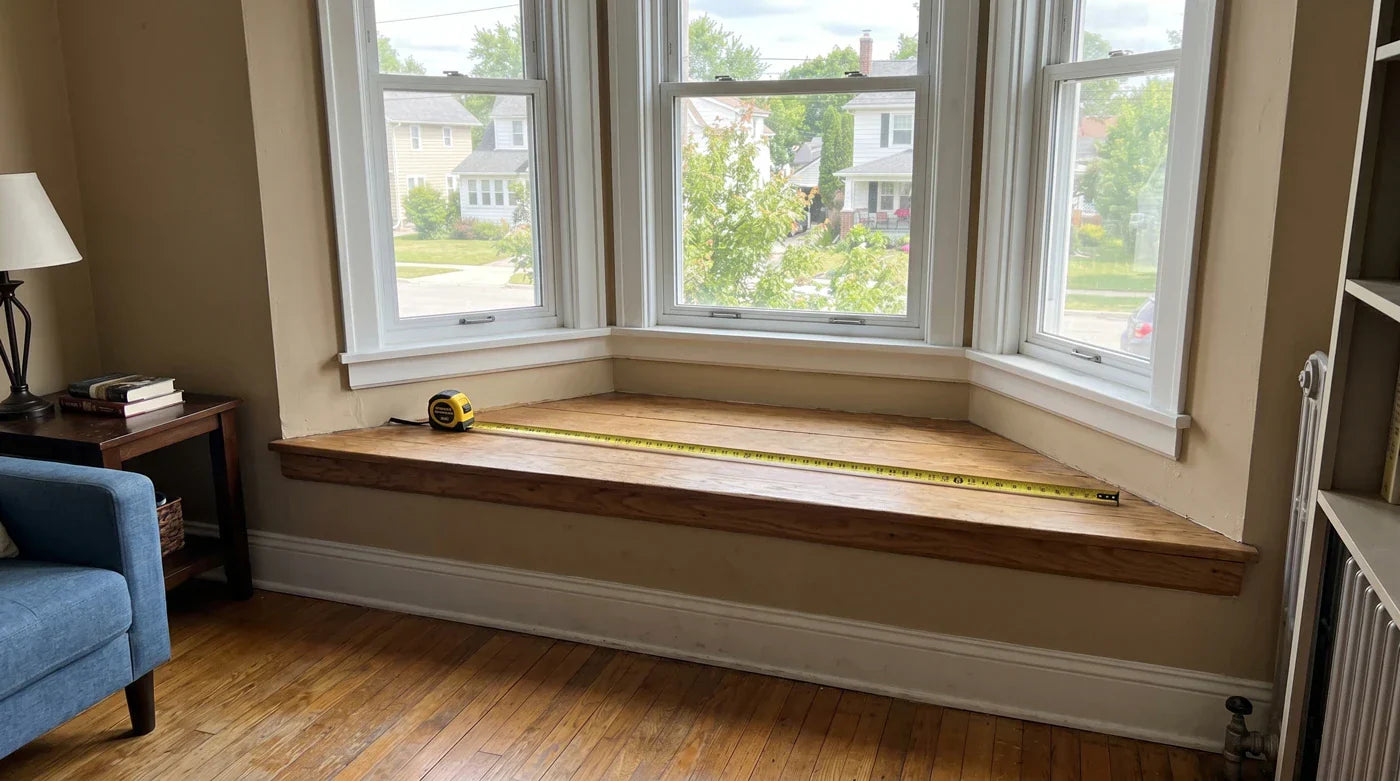
The thing that stops most people from ordering a custom bay window cushion isn't the price or the color choice. It's the measuring. A standard cushion is a known quantity — you can return it if it doesn't fit. A custom cushion is cut to the numbers you provide, and most manufacturing tolerances run around ±1 inch to account for handcrafting. Get the measurements wrong by more than that, and you're usually looking at a restocking fee on a remake — commonly around 50% of the order if the mistake was in the measurements you provided rather than a production error.
That sounds more intimidating than it actually is. The process takes about ten minutes, requires a tape measure and nothing else, and has exactly one common mistake that causes most of the problems. This walks through it precisely.
What you'll need
- A tape measure (cloth or metal, either works)
- A notepad or your phone's notes app
- About 10 minutes
- No old cushion required — measure the seat itself
Why Bay Windows Need a Different Measurement Approach
Most bay windows are trapezoidal — wider at the back (against the wall) and narrower at the front, or vice versa, with the two angled side edges connecting them. A standard rectangular cushion measurement process (just width and depth) doesn't capture this shape. A trapezoid cushion needs four numbers: front width, back width, depth, and thickness. Missing any one of these, or measuring the wrong thing for any of them, is how most fit problems happen.
The Four Measurements, Step by Step
Back Width — the wall-side edge
Measure along the back edge of the seat, the side that sits against the wall under the window. This is usually the longer of the two parallel sides in a typical bay window. Run the tape measure flat along this edge, corner to corner, and record the number to the nearest quarter inch.
Front Width — the room-facing edge
Measure along the front edge of the seat — the side closest to the room, parallel to the back edge. In most bay windows this is shorter than the back width, since the window typically angles outward from the wall. Same process: flat tape measure, corner to corner.
Depth — measured straight, not along the angle
This is the measurement that causes the most problems, and it's worth slowing down for. Depth is the distance from the front edge to the back edge, measured straight through the center of the seat — not along either of the angled side edges.
Manufacturer guidance on this is consistent: take the depth measurement two or three times, at slightly different points along the seat if it's not perfectly even, and use the average. Window seats are rarely built with perfect precision, and averaging a few readings produces a more reliable number than a single measurement that happens to land on a slightly uneven spot.
Thickness — based on comfort, not the existing cushion
Thickness is the one measurement that isn't really "measuring" — it's a decision. Bay window trapezoid cushions are typically available from 2 to 5 inches, adjustable in 1-inch increments. For a seat used for short sitting (a decorative window seat, occasional use), 2–3 inches is adequate. For a reading nook or a spot used for extended periods, 3–4 inches provides noticeably better comfort.
If you're unsure, a simple trick: stack two or three hardcover books on the bare seat and sit on them to get a rough sense of how much lift feels right. That gives you a reasonable starting point without overthinking it.
How Much Room for Error Do You Actually Have?
For bench-style cushions specifically, manufacturer guidance suggests adding an extra 0.5 to 1 inch to your measured length and width before submitting the order. This creates a slightly snug fit rather than an exact-to-the-decimal match, which in practice looks and performs better — a cushion sized to the bare minimum measurement can appear to bulge or sit awkwardly once the foam settles, while one with a small intentional margin sits flat and full.
What Happens If You Get It Wrong
Worth knowing this upfront rather than discovering it after the fact. Custom cushion orders typically go through a confirmation step — most manufacturers will message you within 24 hours of ordering to confirm the submitted measurements before production starts. This is the moment to catch an obvious error (a number that's clearly off, a missing measurement) before cutting begins.
Once production starts based on the measurements provided, the cushion is cut to those numbers. If the dimensions turn out to be wrong because of a measuring error on the customer's side — not a manufacturing mistake — most custom cushion makers apply a restocking fee for a remake, commonly in the range of 50% of the order value. This is standard across the custom cushion industry, not specific to any one manufacturer, because the materials and labor for a custom-cut piece can't be resold as-is.
| Scenario | Typical outcome |
|---|---|
| Measurement error caught during 24-hour confirmation | Corrected before production starts — no cost, no delay beyond the confirmation window |
| Measurement off by less than 1 inch | Covered by standard manufacturing tolerance — cushion ships as ordered |
| Measurement error discovered after production (customer's measuring mistake) | Restocking fee typically applies for a remake — commonly around 50% |
| Cushion doesn't match the submitted measurements (manufacturer error) | Remake or refund at no cost to the customer |
None of this is meant to be alarming — it's meant to explain why the confirmation step exists and why it's worth actually reading the confirmation message rather than letting it sit unanswered. Double-checking your numbers during that 24-hour window is the single easiest way to avoid any of the costlier outcomes.
Before You Submit Your Order
- Measured back width along the wall-side edge, corner to corner
- Measured front width along the room-side edge, corner to corner
- Measured depth straight through the center — not along the angled sides
- Took the depth measurement two or three times and used the average
- Added 0.5–1 inch to length and width for a snug, non-bulging fit (bench-style cushions)
- Decided on thickness based on intended use, not just matching an old cushion
- Double-checked all four numbers before submitting
- Will actually read the confirmation message when it arrives within 24 hours

$60 off orders over $300 · $125 off orders over $500
Applied automatically at checkout. Free US shipping.If Your Window Doesn't Fit This Pattern
Some bay windows have more than three sides, curved transitions instead of sharp angles, or a seat that isn't a clean trapezoid at all. For these, the four-measurement method above is a starting point but may not capture everything needed for an exact cut. Most custom cushion makers, including Rulaer's bay window cushion line, offer direct support for unusual shapes — sending a few photos along with your best attempt at the standard measurements is usually enough for their team to work out the right approach, rather than guessing alone.
It's also worth checking the full custom cushion collection if your window seat turns out to need a genuinely non-standard shape — corner units, curved bays, and multi-angle windows sometimes fall into a different product category than a standard three-sided trapezoid.
The Short Version
Four numbers: back width, front width, depth measured straight through the center, and thickness. The depth measurement is the one to be careful with — measure straight, not along the angled sides, and average a couple of readings. Add a small margin for bench-style cushions. You have about an inch of tolerance built in, which is more forgiving than most people assume going in. And read the confirmation message when it arrives — that's the actual safety net, more than the measuring itself.
Four numbers.
One cushion that actually fits.
90+ colors · custom thickness from 2"–5" · ±1" tolerance · confirmed before production
$60 off $300+ · $125 off $500+ · Applied automatically at checkout




Leave a comment
All comments are moderated before being published.
This site is protected by hCaptcha and the hCaptcha Privacy Policy and Terms of Service apply.