
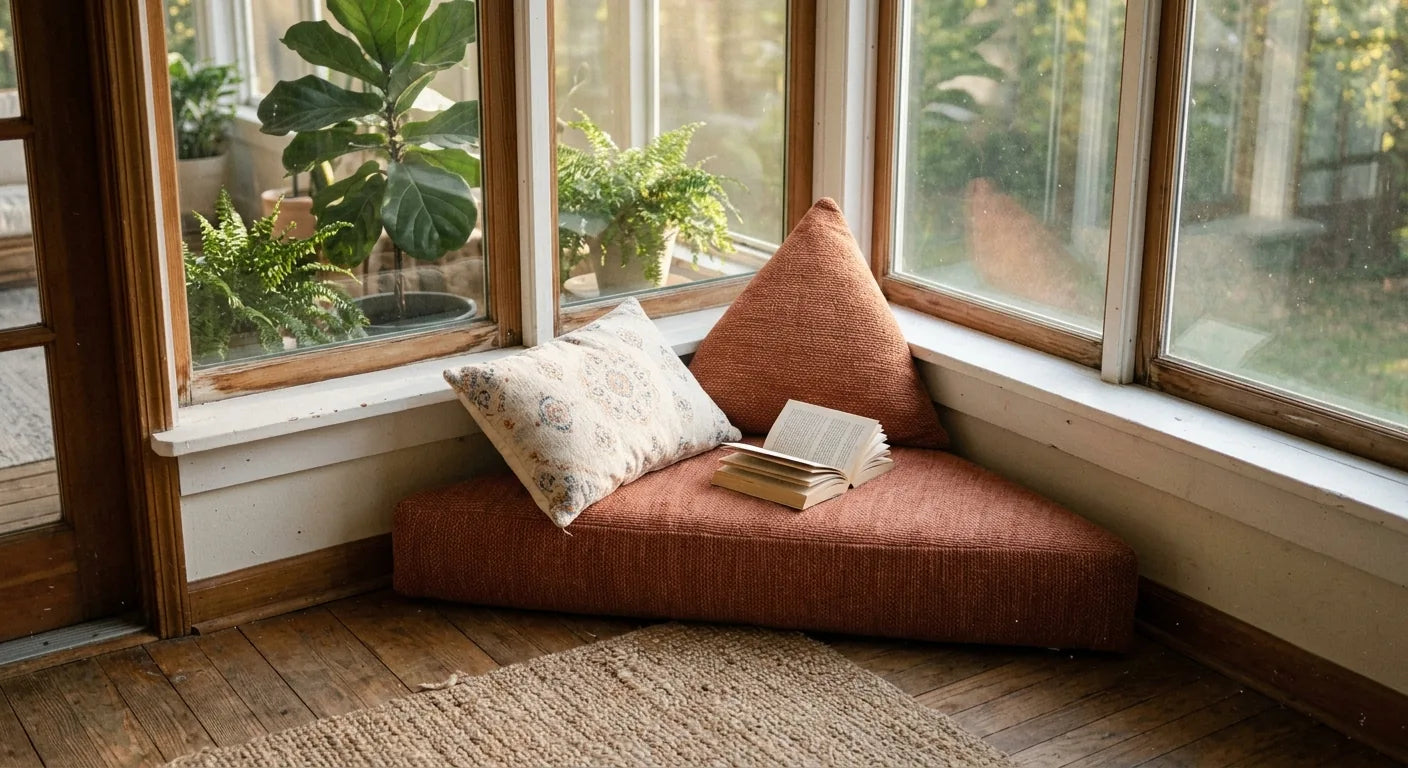

How to Choose the Right Corner Floor Cushion for Your Reading Nook
By the Rulaer team — makers of the Cozy Corner Floor Cushion
I get some version of the same email almost every week: "I love the corner cushion, but which size do I actually need?" And honestly, I don't blame anyone for asking. A corner floor cushion isn't like a throw pillow you can just eyeball — it has two straight edges that have to sit flush against your walls, and if you guess wrong, you either end up with a gap you can see daylight through, or a cushion that's fighting your baseboards for space.
So instead of writing another generic "what is a floor cushion" post, I wanted to sit down and actually answer the size question properly, using our own measurements, our own fabric specs, and a few notes from customers who've already gone through this. If you're trying to decide between a 24-inch cushion and a 40-inch one, this is the guide I wish existed before we launched ours.
What Is a Corner Floor Cushion?
A corner floor cushion is a triangular (sometimes called wedge-shaped) cushion built specifically to fit into the 90-degree angle where two walls meet. Instead of the round or square floor pillows you're probably picturing, the two straight edges of the cushion sit flush against your walls, and the front curves or angles outward to form your seat. That shape does two things a regular floor cushion can't: it uses the "dead" corner space that's usually wasted, and it gives you back support from the walls themselves without needing a headboard or a bolster.
Ours, the Cozy Corner Floor Cushion, is filled with sponge particles and silk floss cut from high-density foam, wrapped in a brushed polyester fleece that's soft enough for bare skin but holds its shape after months of daily sitting. It's part of our broader Floor Cushion collection, which also includes round and square options if a triangle isn't quite what your room calls for — more on that trade-off later.
What Size Corner Floor Cushion Do I Need?
Here's the short version, then I'll walk through the reasoning: measure the two walls from the corner point outward, subtract about 2 inches for wall trim and airflow, and match that number to the closest size below. Go slightly smaller rather than slightly bigger — a cushion that's an inch under is barely noticeable, but one that's an inch over will bow the fabric or push into your walking path.

The one thing people forget: you're not just measuring the corner, you're measuring the corner minus whatever's already eating into it — a floor vent, a radiator, an outlet you don't want covered, or a door that swings into that space. Stand in the corner, close the door if there is one, and picture where a seated adult's knees would land. If that spot lands inside a doorway swing, size down.
Corner Floor Cushion Size Chart
All eight of our Cozy Corner Floor Cushion sizes are 6 inches thick, so the only variable you're really choosing is the footprint. Here's the full lineup, straight from our own product specs:
| Size (in) | Size (cm) | Thickness | Best for |
|---|---|---|---|
| 24 x 24 | 61 x 61 | 6" | Small bedroom or closet corner, single child |
| 26 x 26 | 66 x 66 | 6" | Small apartment corner, kids' playroom |
| 28 x 28 | 71 x 71 | 6" | Compact reading corner, older kids or teens |
| 30 x 30 | 76 x 76 | 6" | Average adult reading nook |
| 32 x 32 | 81 x 81 | 6" | Bay window corner, casual seating |
| 34 x 34 | 86 x 86 | 6" | Cross-legged sitting with room to stretch |
| 39 x 39 | 99 x 99 | 6" | Large living room corner, adult lounging |
| 40 x 40 | 102 x 102 | 6" | Two people, meditation space, media room |
If none of the eight land exactly where you need them — say your corner is an odd 36 inches because of an old radiator — reach out before ordering. We also make custom cushions for spaces that don't play by the rules.
24–28 Inch Corner Cushions: Small Spaces & Kids
This is our most popular range for a kids reading nook cushion, and it makes sense — a 24 or 26 inch cushion doesn't swallow a bedroom corner, and it's still plenty big for a kid to sit criss-cross with a stack of picture books. A few parents have told us they like the 28 inch size for a shared sibling nook, since two smaller kids can squeeze in without elbowing each other. If the corner is inside a closet-turned-reading-spot, or you just want to leave enough floor for a bookshelf and a lamp, stay in this range.
30–34 Inch Corner Cushions: The Standard Reading Nook

This is the range most adults land on when they're searching for a corner cushion for reading nook use. A 30 or 32 inch cushion is roomy enough to sit cross-legged or lean sideways against one wall while your legs stretch across the other, which is honestly how most people actually read on the floor. The 34 inch size gives you a bit more breathing room if you like to sprawl, or if the corner also doubles as a spot to fold laundry or sort mail (no judgment, we've all been there).
39–40 Inch Corner Cushions: Big Corners & Grown-Up Lounging
These are our large floor cushion sizes, and they're built for corners that can actually take up the space — open-concept living rooms, finished basements, a wide bedroom corner that's otherwise just collecting dust. A 39 or 40 inch corner floor cushion for adults is big enough for two people to sit side by side, or for one person to genuinely lie down at an angle across it, which is popular with folks setting up a meditation or yoga cool-down corner. It's also the size we see most often paired with a floor lamp and a low side table to make a real secondary seating area, not just a floor accent.
How Thick Should a Floor Cushion Be?
Every size of the Cozy Corner Floor Cushion is built at 6 inches thick, which is on the plush end compared to a lot of floor cushions on the market that top out at 2 to 3 inches. There's a reason for the extra padding: you're sitting directly on the floor with no chair frame underneath you, so the cushion is doing all the work a sofa's frame and springs would normally share. A thin cushion looks fine in photos but flattens under real body weight within a few sittings, and you end up feeling the hard floor through it anyway.
According to a recent breakdown of upholstery foam by Universal Upholstering, foam density and firmness aren't the same thing — a cushion can be dense and still feel soft, which is roughly the balance we're aiming for by pairing high-density foam particles with a silk floss layer instead of just carving a solid foam block. That combination is part of why the 6 inch thickness holds its shape instead of packing flat within a season, and it's also why our square and round floor pillows, which are meant for lighter, more occasional sitting, are built thinner at 2 inches.
Corner Cushion vs. Round Floor Pillow: Which Shape Do You Need?

This question comes up almost as often as the sizing one. Here's how I'd break it down:
- Choose a corner cushion if you're actually placing it in a 90-degree corner and want the wall to double as back support — it fills the space edge to edge with no gap.
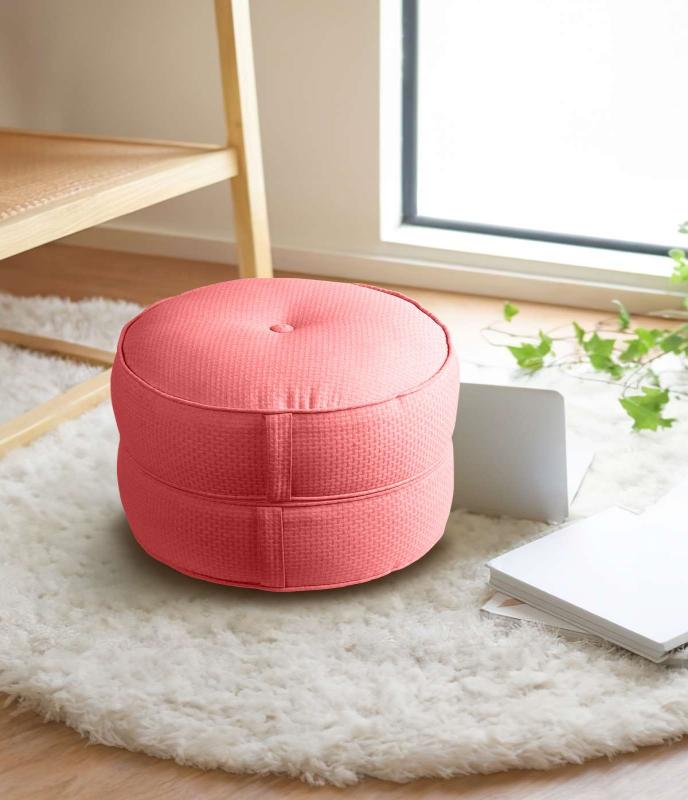
- Choose a round floor cushion if you want something you can move around the room, use in the middle of the floor for game nights, or shift between kids' rooms without it looking out of place anywhere.
- Choose a square floor cushion if you like a cleaner, more tailored look under a window seat or paired symmetrically with other square decor.
A round cushion pushed into a corner will always leave a triangle-shaped gap of bare floor behind it — that gap is exactly the space our corner cushion is designed to use instead.
Best Filling for a Corner Floor Cushion
The inside of the Cozy Corner Floor Cushion is sponge particles combined with silk floss, both cut from high-density foam rather than loose beads or shredded fiber. That matters more than people expect — loose bean-style fillings shift and clump within weeks of daily use, which is why bean bags need re-fluffing so often. Sponge-and-silk-floss fill stays lightweight and breathable but keeps its shape sitting after sitting, and it recovers faster once you stand back up. The outer cover is a brushed polyester-nylon blend (95% polyester, 5% nylon) that's soft against skin, resists pilling, and holds its color well over time.
Where Can You Use a Corner Floor Cushion?
Reading nooks get the most attention, but that's genuinely just the start. A few setups our customers have shared with us:
- Meditation corners — the wall support keeps your posture upright without a separate bolster.
- Kids' playrooms — soft landing zone that also works as extra floor seating for screen time.
- Bedroom accent corners — a cozy spot to put on shoes or fold laundry that still looks intentional.
- Dorm rooms and studios — extra seating that doesn't need a footprint of its own, since it tucks into space you weren't using anyway.

How to Create a Reading Nook Around Your Corner Cushion
You don't need a full room makeover for this. A home-organization guide from Extra Space Storage points out that floor pillows are one of the easiest ways to add reading-nook seating without committing floor space to a full chair or sofa, since they can simply tuck away when the room needs to serve another purpose. Add a small side table or basket for your current book, a warm-toned lamp positioned so it doesn't glare off the page, and maybe a throw blanket draped over the corner cushion for cooler evenings. That's really it — the cushion is doing most of the visual and physical work already.
A Few Corner Floor Pillow Options to Compare
FAQs
What size corner floor cushion is best for adults?
Most adults are comfortable in the 30–34 inch range for everyday reading or lounging. If two people will share the cushion, or you want room to stretch out fully, go with the 39 or 40 inch size instead.
Can a corner floor cushion work as a permanent reading nook seat?
Yes — the 6 inch high-density foam and silk floss fill is built for daily sitting, not occasional use, and the cover is removable-style fabric that holds up to regular contact.
How much floor space does a corner reading cushion actually need?
Measure both walls from the corner point and leave 2–4 inches of clearance for baseboards and foot traffic. A 30 inch cushion typically needs about 32–34 inches of clear wall on each side once you account for that buffer.
Are corner floor cushions good for a kids' reading nook?
Very much so — the 24 to 28 inch sizes are popular for kids specifically because they're large enough to sit or half-recline in, but small enough to leave room for a bookshelf or toy bin nearby.
Is a corner cushion better than a bean bag for a reading nook?
For daily use, generally yes. Bean-style fillings shift and lose shape with regular sitting, while a sponge-and-silk-floss fill inside a fixed triangular shape holds its form and gives you back support from the wall, which a bean bag can't.
Measure Once, Sit Happily Ever After
If there's one thing I'd want you to take away from all this, it's just: measure your corner before you scroll through eight size options and guess. It takes two minutes with a tape measure and it's the difference between a cushion that looks built-in and one that looks like it wandered in from another room. Once you've got your number, matching it to a size on the chart above is the easy part.
Ready to find your fit? Browse all eight sizes of the Cozy Corner Floor Cushion, or explore the rest of the Floor Cushion collection if a round or square shape fits your space better. And if your corner is an odd size the chart doesn't cover, just message us — we'll figure it out together.



Leave a comment
All comments are moderated before being published.
This site is protected by hCaptcha and the hCaptcha Privacy Policy and Terms of Service apply.