
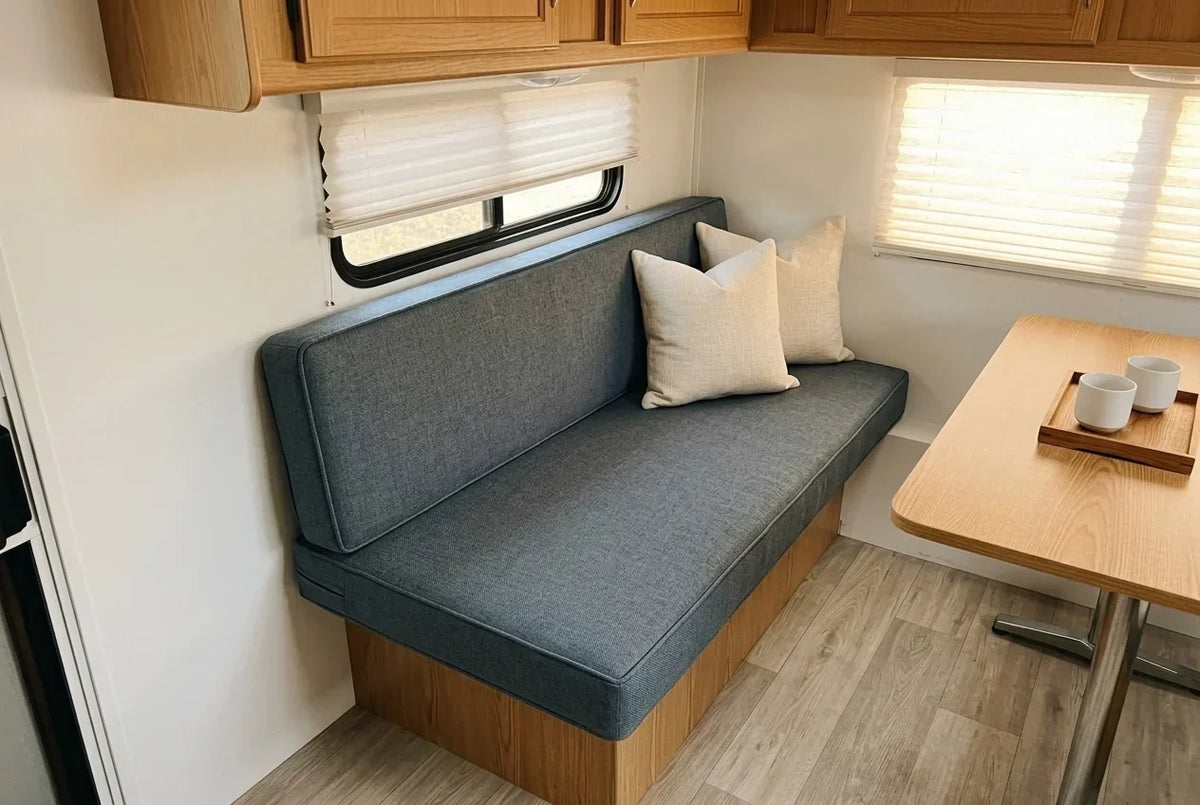

There's a particular sound an old RV dinette makes when you sit down. A soft sigh from the foam, then your tailbone finds the plywood. If you've heard it, you already know why you're reading this.
The note we get from RV owners usually goes something like: the cushions were great when we bought the rig, now they're pancakes. Somebody's sleeping on the jackknife sofa with a folded comforter for padding. The dinette back cushion keeps sliding down behind the seat. And nobody wants to guess at an angled corner, place an order, then find out weeks later it's off by an inch. Fair enough.
So here's the walkthrough I'd give a friend at the campground. How to tell if it's really replace-time, how to measure custom RV cushions for a dinette and a jackknife sleeper sofa, and what to pick in foam and fabric when every pound and every inch of clearance counts. The reading is a bit long, the actual measuring takes about an hour.
First, the Sit Test (Before Fall Camping Season Sneaks Up on You)
Not every tired cushion needs replacing, and there's no point spending money you don't have to. Sit down on the dinette the way you would after a long driving day, all the way back, no perching. If you can feel the plywood edge or the seat frame, the foam has bottomed out. That's the big one.
Other signs worth noticing:
- A permanent dip where the same person always sits (we all have our spot)
- Foam that's gone yellowish and crumbly, or leaves dusty bits when you peek in at a seam
- Back cushions that lean forward and refuse to stay upright
- A musty smell that doesn't leave after a day airing in the sun. An RV is a small closed box, and foam soaks up humidity in storage
- Seams opening up, or fabric gone thin and shiny right where you slide in and out of the booth
Here's the part people skip: figure out whether it's the foam or the fabric that's finished. If the foam still springs back when you press it and only the cover is tired, a new cover might be all you need, and we walk through that choice in replacement cushion covers vs. new foam. If the foam is dead, replace it, and honestly once the foam is coming out a fresh cover is a small extra. One decision, done.

What to Grab Before You Measure (Short List, Promise)
No special tools. A metal tape measure for the straight runs (soft sewing tapes sag over long spans), and a bit of string if you have curves to trace. Then a notepad or phone notes, painter's tape and a marker, a big sheet of cardboard for odd shapes, and your phone camera.
Pull every cushion out first. Snap a photo of each empty seat, then tape a label on each cushion: "Dinette door-side seat", "Dinette door-side back", "Sofa seat", "Sofa back". Sounds fussy. But once they're all piled on the floor they look identical, and an angled piece is usually the mirror image of the one across the table. Ask me how I know.
Field note
Measure the platform, not the old cushion. Worn foam has compressed and the cover has stretched, so numbers taken from a tired cushion can be off by more than you'd expect. Measure the plywood deck the cushion sits on. It's the same advice in our measurement guide. If something's blocking the platform and you have to measure the old cushion, write that in your notes.

How to Measure RV Dinette Cushions: Seats, Backs and Those Weird Corners
RV walls aren't square. I say this every time, and every time someone finds a half-inch difference between the front and back edge of a booth seat. So don't take one number and call it a day. Work through these in order:
- Length, twice. Measure the front edge and the wall-side edge separately and write both down. If they differ, that's normal, and it's exactly why custom RV cushions exist.
- Depth, front to back. Measure at both ends and in the middle. Close numbers? Average them. Not close? Note the difference.
- Angled or curved corners. Measure each side of the cut, then lay cardboard on the platform, trace the outline and cut it out as a template. Photograph the template with a tape measure next to it. This single step saves more headaches than anything else on this list.
- Thickness. The one people guess at. Sit with your legs under the table and check how your thighs clear the edge. If your current cushion is 3" and you jump to 5", the table will let you know. For most dinette seats, 3 to 4 inches is the sweet spot.
- Backrests. Measure the back panel's height and width, and notice whether the cushion should taper, thicker at the bottom and thinner at the top. Back cushions usually run thinner than seats, around 2 to 3 inches, so they don't push you forward.
- Storage lids and hinges. Plenty of dinette seats lift up for storage. If yours does, the cushion has to lift with it, and a chunky one can fight the table when you open the lid. Note where the hinges and finger pulls are.
- Your fit allowance. If the seat is walled in on multiple sides, take about 1/2 inch off both length and width so the cushion drops in without a wrestling match. That's what our measurement guide says for built-in seating. Open edges? You can match the platform. Handcrafted cushions can vary by about ±1 inch, so flag any tight spot in your order note. And if the depth varies, take several readings and average them, that keeps the cushion from bulging in the middle.
Here's how I'd write it all down. The numbers are just an example, not your rig.
| Cushion | Length (front / wall) | Depth | Thickness | Notes |
|---|---|---|---|---|
| Dinette seat, door side | 48" / 47.5" | 21" | 4" | Angled corner, storage lid |
| Dinette back, door side | 48" | 22" tall | 3" bottom, 2" top | Tapered, rounded top corners |
| Jackknife sofa seat | 72" | 30" | 4" | Notches at hinge brackets |
Stuck on a strange shape? The measurement guide also mentions a consultation service, where a specialist looks over your photos and numbers before you order. Worth using if your booth has more angles than a geometry test.

RV Jackknife Sleeper Sofa Replacement: Where People Get Tripped Up
A jackknife sofa is the one that folds flat into a bed: a seat pad, a back pad, and a metal frame that hinges in the middle. Simple, until you order the wrong thickness and the frame refuses to close. A few things to know before you start an RV jackknife sleeper sofa replacement.
Measure each pad on its own
Seat and back are almost never the same size, and some have notched corners for arm brackets or hinge hardware. Cardboard template again. Yes, again.
Thicker isn't always better
When the sofa is in sofa mode, the pads get squeezed together near the hinge. A quick test: fold a bath towel to the thickness you're considering, tuck it into the hinge zone, and see if the frame still closes and latches without a fight. If it fights you, go thinner.
Remember it's a mattress too
For anyone sleeping on it nightly, those pads are your mattress. Firm high-density foam keeps you from feeling the frame underneath. To be realistic, a new pad will soften that bar across the middle but nothing erases a metal hinge completely. For the occasional guest, 3 to 4 inches is plenty. Sleeping on it every night? Go to the top of whatever clearance you have.
If your pads have curved edges or cutouts, email us the photos and your cardboard template and we'll work out the shape with you before anything gets cut.

Foam, Weight and Fabric: Durable Without Hauling Extra Pounds
This is where I put on my factory hat. We've been making cushions since 2013, and most of what goes wrong with RV cushions is decided by the foam, not the fabric.
In a lot of factory-built rigs the seat foam is on the thin, light side, because cost and weight both matter to whoever builds the coach. It feels fine in the showroom, then flattens in a season or two. When you replace, spend your money here first. Ask any supplier for the density in pounds per cubic foot, and for everyday sitting look for around 1.8 or higher. Our custom-sized high-density foam is listed at a density of 1.8 with an ILD of 44 (ILD is basically firmness, higher means firmer), and we can supply it from 1 to 7 inches thick. For seats, we recommend 3 to 4 inches. Heavier folks, go thicker, within your clearance.
Two foam styles we work with, and how I'd use them in a camper:
- K6 high-density rebound foam. Supportive, springy, tears less easily and breathes well. My pick for dinette seats and jackknife sofa pads, the pieces that carry your weight every day.
- Sponge particles with silk floss. Cut from high-density sponge, lighter, keeps a neat shape, no smell, decent bounce. Nice for back cushions or wherever you're watching payload.
On weight, some rough math, foam only: at 1.8 pounds per cubic foot, a 48 × 21 inch seat pad holds about 4 lb of foam at 4 inches thick, and about 6 lb at 6 inches. Multiply that by every cushion in the rig and the "just make it thicker" habit adds up, on top of costing you table clearance. Right-size it. That's the real lightweight trick.
Fabric next. A dinette is a high-traffic zone: sliding in and out, jean rivets, dog claws, coffee on a bumpy road. Tight weaves and performance fabrics hold up better, and darker or textured patterns hide wear better than light solids. When comparing suppliers, ask about abrasion ratings (double rubs). 15,000 or more is generally treated as heavy-duty. If your rig sits in the sun a lot (windows count), outdoor-grade fabric resists fading better than regular upholstery cloth, which is why our RV cushions use outdoor fabric, with more than 90 colors to pick from.
And the small construction stuff that matters on the road. Our custom RV camper seat cushion has a zippered cover that comes off easily, three lacing options to stop cushions creeping while you drive, a non-slip bottom in three colors, and piping for a tidy edge. For cleaning, a gentle wipe with a damp cloth is what the product page recommends.

Ordering Custom RV Cushions: Timeline, Notes and Snowbird-Season Planning
Once you have your numbers, ordering is the easy part. On the product page you enter your dimensions, pick thickness and color, and add each cushion to your cart. Use the "Add order note" box at the bottom of the cart for anything unusual: zipper location, ties, or which cushion is the mirror image of which.
Here's the bit people miss. For custom-size RV and camper cushions, we send a confirmation message after you order, and we finish confirming the details within 24 hours. Reply quickly, because if we don't hear back, production starts on what's in the order. Spot a mistake yourself? Changes and cancellations are usually free within 48 hours.
Timing: custom cushions usually take about 3 to 4 weeks from when we have your exact specs, and Rush Delivery gets it down to around 2 weeks. Shipping is free across the US. Cushions ship vacuum-packed, so give them a day or two to expand before you judge the fit. I like fall for this project because the rig is either about to be parked for winter, or it's about to be the Thanksgiving-and-snowbird workhorse. Order now and new cushions can be in before the holiday trips. Wait till deep winter storage and you'll be sitting on fresh foam the first weekend of spring, which is also fine.
Still weighing replacement against recovering what you have? We put real numbers on it in how much it costs to recover RV dinette cushions.
Autumn limited-time offer
20% off with code rulaer20
Enter it at checkout. Good timing if you're redoing the dinette and the jackknife sofa before the holiday trips. This offer can't be combined with other discounts, and it's for a limited time, so check your cart for the latest.
Mistakes We'd Love You to Skip
- Measuring the squashed old cushion instead of the platform
- Taking one measurement per side, in a rig where nothing is square
- Using the same thickness for seats and backs
- Forgetting table clearance until the new foam is in your lap
- Skipping labels, then ordering "the left one" and wondering which left
- Ignoring our confirmation message after checkout
- Picking fabric only for looks when it's going to live through dogs, kids and sun

Quick Answers for RV Owners Before Winter Storage
Can I just buy foam and cut it myself?
You can, and plenty of people do. Our foam listing even suggests a bread knife or electric cutter for trimming. It works fine for a plain rectangle. For tapered backs, angled corners and notched sofa pads, a clean edge is hard and a jagged cut shows up as lumps under the cover. Send us the shape and we'll quote it.
How thick should camper foam cushions be?
Seats are usually best at 3 to 4 inches, backs a bit thinner. Check table clearance for dinettes and folding clearance for jackknife sofas before you settle.
Will custom cushions add a lot of weight?
Not if you right-size the thickness. Use the lighter foam for backs if payload is tight, and keep the firmer foam where you actually sit.
Can I replace only the cover?
Yes, if the foam still springs back. That's what the cover option below is for.
What if my measurements are off?
Custom cushions are cut and sewn to your numbers, which is why we confirm details with you right after you order and why measuring twice matters so much. Tell us fast if something's wrong, since there may be a small fee once production has started. Our 3-year warranty covers material, structural and craftsmanship issues that are our responsibility, and the full details are on our warranty page.
One Quiet Morning, One Tape Measure
That's really all it takes. Pick a quiet morning, make coffee, pull the cushions, and write everything down twice. Standard dinette plus a jackknife sofa, plan on about an hour. If you'd like a second pair of eyes on your numbers before you order, send them our way, that's what our team is for.
Start your custom RV cushion order
Custom RV Camper Seat Cushion
Zippered cover over firm high-density foam. Choose your size, thickness and color, plus lacing and a non-slip bottom for the road.
See the cushionCustom RV Seat Cushion Cover
Foam still bouncing back? Refresh just the fabric before the next trip.
See the coverCustom-Sized High-Density Foam
Foam only, density 1.8 and ILD 44, from 1 to 7 inches thick. Handy for camper foam cushions when your covers are fine.
See the foam




Leave a comment
All comments are moderated before being published.
This site is protected by hCaptcha and the hCaptcha Privacy Policy and Terms of Service apply.