
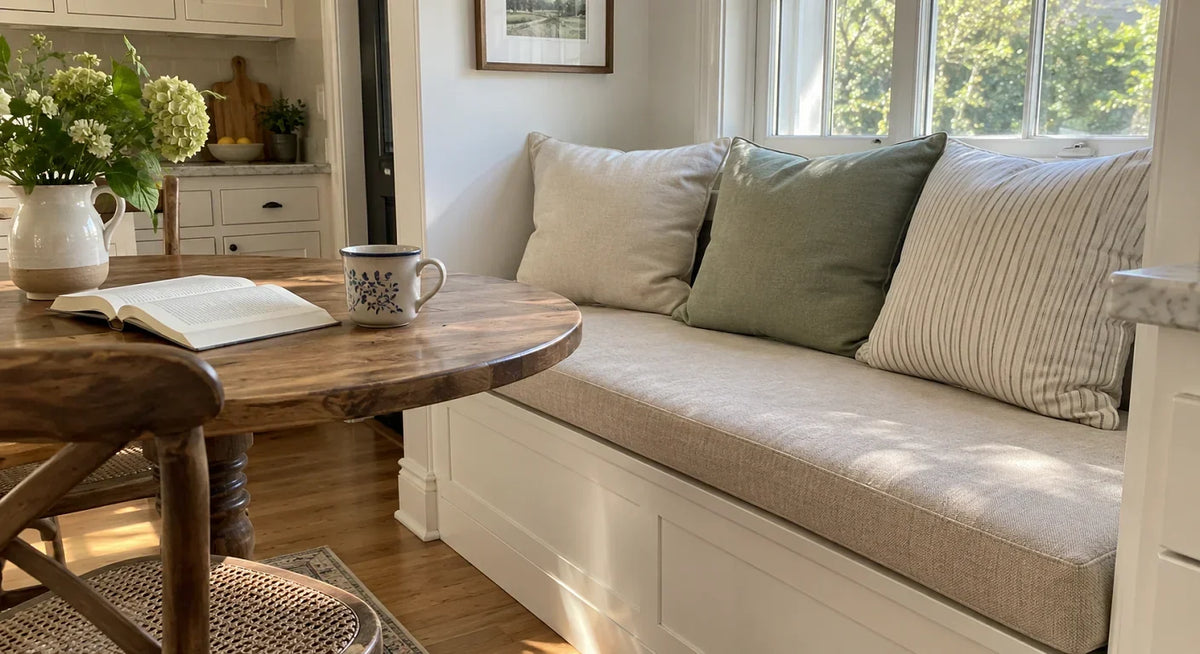
A breakfast nook can be one of the nicest places in the house. Morning coffee, homework after school, a slow Sunday breakfast, somebody opening a laptop while dinner is cooking—it tends to become more than a place where you eat.
But there is a problem we see quite often with built-in breakfast nooks: they look much more comfortable than they actually feel.
The bench is beautiful. The table fits perfectly. Maybe there are a few throw pillows in the corner. And still, twenty minutes into a meal, somebody starts shifting around, leaning forward or moving to a regular dining chair.
Usually, the problem is not the breakfast nook itself. It is the seating setup.
A breakfast nook cushion has to do more than soften a wooden bench. It changes your seat height, affects how easily you slide in and out, determines how supported you feel during a meal, and has to fit a space that was probably never built to a standard furniture size.
So instead of starting with fabric color or whether you like piping, it makes more sense to ask a different question:

1. The Cushion Is Too Thick—or the Bench Is Already Too High
Thickness is usually the first thing people notice when shopping for a cushion. A thicker cushion looks softer, so it is tempting to assume that more thickness automatically means more comfort.
For a breakfast nook, that is not always true.
A dining bench works together with the table. If the wooden platform is already fairly high, adding a thick cushion can raise your knees, reduce the clearance underneath the table apron and make the seating position feel strangely cramped.
On the other hand, a very thin cushion over a hard plywood or wooden platform may feel fine for ten minutes but not for a long breakfast or family dinner.
This is why we prefer thinking about finished seat height, not cushion thickness by itself.
Bench platform height + cushion thickness = finished seat height.
Before ordering anything, try a surprisingly low-tech test: stack folded towels, a folded blanket or a temporary piece of foam on the bench until you reach the thickness you are considering. Then actually eat a meal there.
Check your knees. Check the table edge. Can you sit upright without feeling too high? Can you slide out without bumping the underside of the table?
It takes twenty minutes and tells you much more than looking at cushion thickness online.

2. Your Bench Probably Isn't as Rectangular as It Looks
This is especially common with built-in banquettes.
At first glance, the seating surface looks rectangular. Then you measure it and discover the back edge is slightly shorter than the front, one wall is not exactly square, or the two sides of an L-shaped breakfast nook do not meet at a perfect 90-degree angle.
A standard cushion cannot really compensate for that.
You often end up with one of three things: a noticeable gap against the wall, a cushion that overhangs the front edge, or two corner cushions that push against each other and never sit flat.
That is where a custom breakfast nook cushion becomes useful. The point is not simply that it is “custom.” The point is that the cushion follows the bench that actually exists in your home.
If your nook is L-shaped, U-shaped, trapezoid, or has an awkward corner, use our more detailed banquette cushion measuring guide before ordering. That article goes deeper into front and back widths, corner angles, diagonals and paper templates, so we won't repeat all of that here.

3. A Soft Cushion Can Still Be Uncomfortable
Softness and support are not the same thing.
This matters more in a dining nook than people sometimes expect.
A loose, very soft fill may feel cozy when you first sit down, but if it compresses deeply your body ends up closer to the hard bench underneath. It can also make sliding sideways along an L-shaped banquette harder—something you probably do several times during a family meal.
For frequently used breakfast nook seating, a more supportive foam structure normally makes more sense than loose fiber alone. The cushion should compress enough to feel comfortable, then recover rather than staying flattened where everyone sits most often.
From a cushion maker's point of view, this is one place where the intended activity really matters. A decorative window cushion and a dining banquette may look similar in a photograph, but they're asked to do different jobs.
Breakfast nook seating usually needs:
- stable support during longer meals;
- clean edges that don't collapse over the bench;
- reasonable ease when sliding in or out;
- enough resilience for regular family use.
If you are working with a non-standard built-in bench, a made-to-fit custom bench cushion lets you choose the dimensions and thickness around the actual dining space instead of settling for the closest stock size.
4. The Seat May Be Too Deep for the Way You Actually Sit
Deep seating sounds comfortable, but a breakfast nook is not a sofa.
If the bench is very deep, shorter family members may have to sit forward to reach the table. That leaves the back unsupported. Add a thick back pillow and suddenly there may not be enough room left to sit naturally.
A deeper bench can still work beautifully—it just needs to be planned as a system.
Consider the seat cushion, back pillows and tabletop position together rather than treating each piece separately.
For example, if the built-in bench has generous depth, you might use a supportive seat cushion plus removable back pillows instead of trying to fill the entire depth with one oversized seat cushion. This keeps the dining position practical while still letting the nook feel relaxed when somebody stays behind with a cup of tea.

5. The Cushion Keeps Moving Every Time Someone Gets Up
A cushion can fit correctly and still be annoying if it shifts several inches every time someone slides out from behind the table.
This happens often in breakfast nooks because people tend to move sideways across the seat rather than simply standing straight up as they would from a dining chair.
The right fixing method depends on the bench.
A non-slip base can work well on smooth, flat surfaces. Ties may be useful when the bench has rails or attachment points. Hook-and-loop fastening can make sense for some built-in platforms when you want stronger positioning but still need to remove the cushion.
There is no reason to add every fixing method at once. The better choice is the least complicated option that keeps the cushion where it belongs.
Rulaer's indoor bench cushion collection can also help if your nook happens to match a more standard size and you do not actually need a fully custom shape.
6. Your Fabric Choice Needs to Survive Breakfast, Not Just Match the Kitchen
This sounds obvious until the first glass of orange juice tips over.
A breakfast nook is a working part of the house. Coffee, crumbs, jam, children's snacks and weekend takeout all happen there. If the fabric is beautiful but makes you nervous every time someone eats, it probably isn't the right choice for that space.
For an everyday dining nook, think about maintenance before texture.
A removable cover is helpful. So is a fabric that can handle frequent light cleaning without looking tired quickly. Very pale colors can still work, especially in a bright kitchen, but lifestyle matters more than a color trend.
If your breakfast nook gets strong direct sun for several hours every day, that should also be part of the fabric decision.

Before Fall Hosting Season, Sit in Your Breakfast Nook Like a Guest Would
Early fall is when breakfast nooks tend to start working harder again. School mornings return, people spend more time indoors, and before long the same little dining corner is handling weekend brunches, visiting family and holiday overflow seating.
Before changing the decor for fall, do something more useful first: sit there for thirty minutes.
Not while measuring. Not while styling it.
Actually use it.
Ask yourself:
- Do your feet sit naturally?
- Does the table feel too high or too low?
- Do you slide forward while eating?
- Does the cushion move when you get out?
- Does the corner feel crowded?
- Would you willingly sit here through a two-hour dinner?
Those answers tell you more about the cushion you need than a Pinterest photo ever will.

Custom Doesn't Always Mean You Need the Most Complicated Cushion
There is a tendency to over-design custom products.
Once you can choose size, thickness, fabric, piping, ties and other details, it is easy to assume more options means a better result.
Usually the opposite is true.
For a breakfast nook, start with four things:
- Fit: Does it follow the actual bench?
- Finished seat height: Does it work with the table?
- Support: Will it stay comfortable through a meal?
- Maintenance: Can you live with it every day?
After those four are right, then think about piping, tufting, decorative details and color.
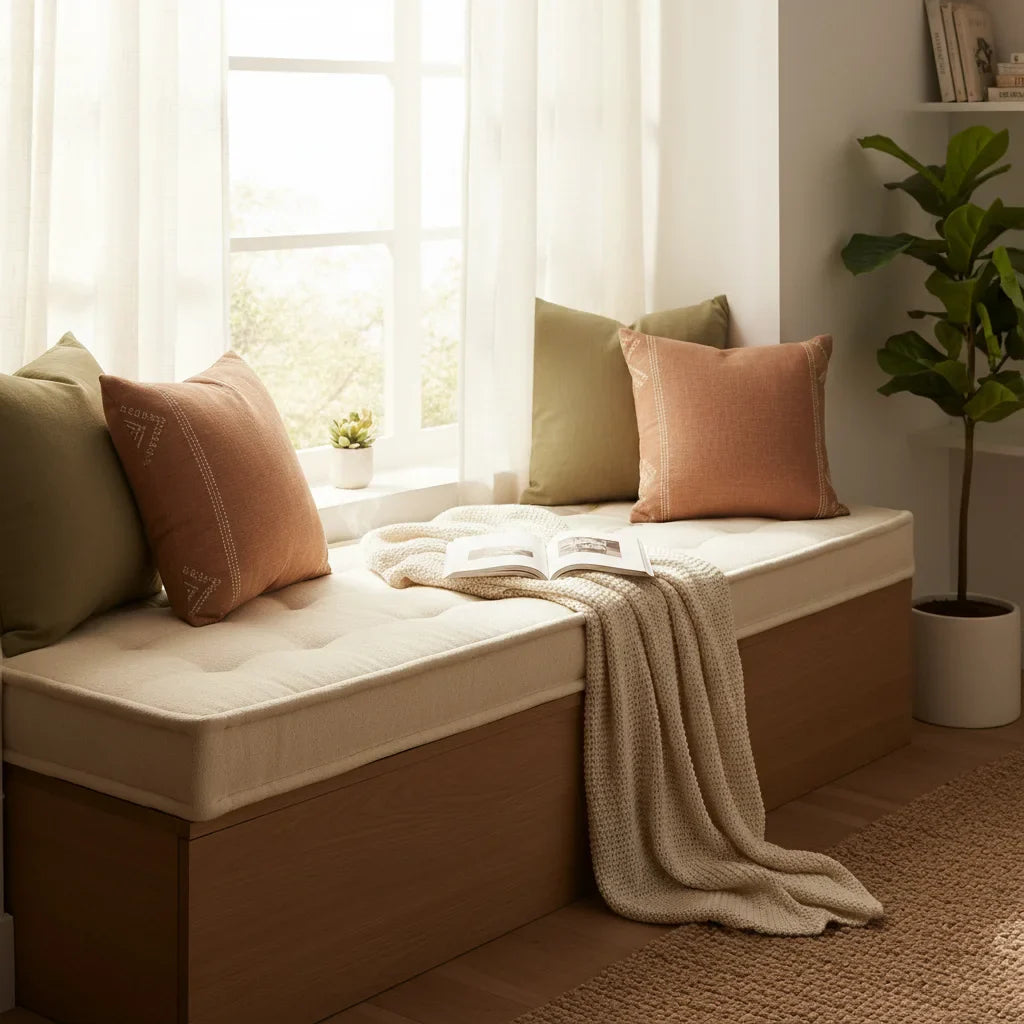
If your priority is a more tailored decorative look, a custom tufted cushion can suit a breakfast nook where you want the cushion itself to become part of the room's design. For a simpler built-in dining bench, a clean box-style cushion may be all you need.
Three Practical Rulaer Options for a Breakfast Nook
Custom Fit Bench Cushion
Best for built-in breakfast nooks with unusual lengths, depths or non-standard dimensions.
Explore Custom Fit →Custom Tufted Cushion
A good direction when the cushion needs to add both everyday comfort and a softer decorative look.
Explore Tufted Options →45-Inch Tufted Bench Cushion
Worth checking first when your nook uses a simpler straight bench close to a standard size.
View the 45-Inch Cushion →A Better Breakfast Nook Starts With How It Feels at 8:00 a.m.
The best breakfast nook is not necessarily the one with the prettiest fabric or the most pillows.
It is the one people actually choose to sit in.
That usually comes down to surprisingly practical details: the cushion fits the built-in bench, the finished height works with the table, the seat has enough support, and you are not constantly pushing it back into place.
Once those things are solved, decorating becomes the easy part.
So if your breakfast nook looks finished but never quite feels right, don't assume the whole space needs redesigning. Sometimes the wooden bench, the table and the layout are already fine. The missing piece is simply seating that was designed around them.

Ready to Fix the Seat You Already Have?
If your breakfast nook is an unusual size, has an awkward corner or simply needs a more comfortable everyday seat, start with the bench itself—not a standard cushion size.
Measure the space, test your preferred finished seat height, and choose the cushion around how your family actually uses the nook.




Leave a comment
All comments are moderated before being published.
This site is protected by hCaptcha and the hCaptcha Privacy Policy and Terms of Service apply.