
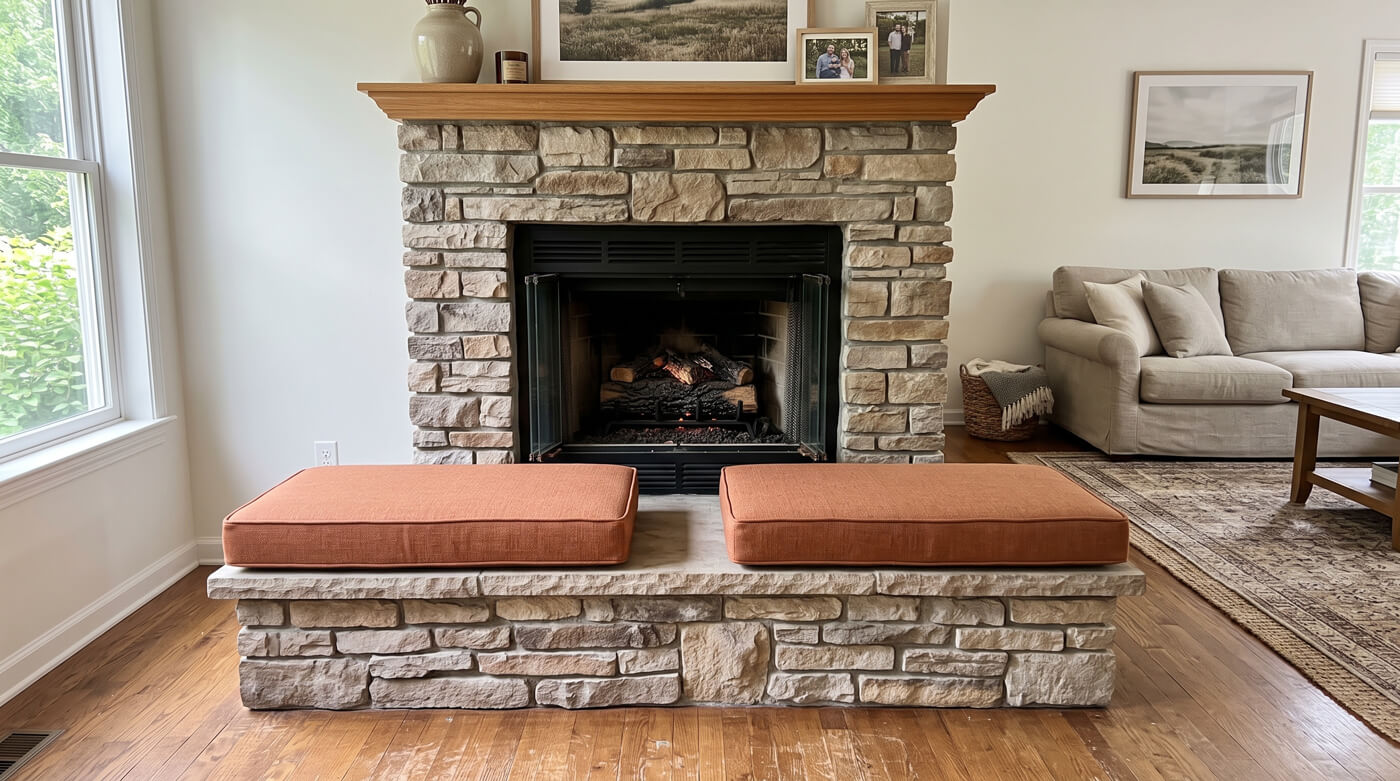
Fireplace-side seating is one of those requests that used to trickle into our inbox once in a while and now shows up almost every week, usually from someone who just finished a family room renovation and is staring at a beautiful stone hearth that's completely uncomfortable to sit near — or worse, is worried about a toddler faceplanting into it. Hearth cushions sit in a weird category. They're not outdoor cushions, so heat and UV rules don't quite apply the same way. But they're also not regular sofa cushions, because they sit a few feet from an actual heat source and open flame. That combination is exactly why we get more safety-related questions on hearth cushions than on almost anything else we build.
One build note before we get into standards and measuring: we don't make hearth cushions as one continuous slab. We cut them as two separate pieces — one for the left side of the hearth, one for the right — with an open gap left directly in the center, in front of the firebox opening. It does two things at once. It keeps fabric out of the zone that runs hottest and catches the most ash and spark fallout, and it means either half comes off on its own for washing instead of wrestling one long cushion in and out of a sink.
Are Fireplace Hearth Cushions Actually Fire-Safe? What CAL 117 and NFPA Standards Cover
This is the question we'd want answered too, so let's be precise instead of vague about it. In the U.S., the relevant flammability standard for cushion foam and fabric is California Technical Bulletin 117-2013 (commonly written CAL 117 or TB 117-2013), which was adopted federally as 16 CFR Part 1640 and now applies to upholstered furniture nationwide, not just in California. Here's the part most people don't realize: TB 117-2013 replaced the old 1975 standard, which tested whether foam could resist a direct open flame for 12 seconds. The current standard tests something different — smolder resistance, using a lit cigarette as the ignition source, applied separately to the cover fabric, any barrier material, and the foam filling itself. You can read the full TB 117-2013 testing requirements directly from California's Bureau of Household Goods and Services if you want the source document.
Why does that distinction matter for a hearth cushion specifically? Because "passes CAL 117" does not mean "won't ignite from a spark or ember" — it means the materials resist smoldering ignition from something like a dropped cigarette or a stray ember that lands and sits. That's actually a reasonably good match for hearth risk (embers, not sustained flame contact), but it's not the same claim as fireproof, and any seller who tells you a fabric cushion is "fireproof" outright is overselling it. What you want to see from a manufacturer is a specific compliance statement — ideally referencing TB 117-2013 / 16 CFR 1640 for the foam and fabric, plus confirmation that any barrier layer used meets the same smolder-resistance testing. If a seller can't tell you which standard their foam was tested against, that's your answer.
We build our hearth and bench cushion cores using foam and covers tested to this standard, and we'd recommend not settling for less no matter who you buy from — see our breakdown of foam types for bench and window seat cushions if you want to compare density and safety tradeoffs before choosing a fill.

Measuring a Hearth With Curved Stone Edges or Extended Molding

Rectangular tape-measure math works fine for a plain plywood bench. It falls apart the moment your hearth has a bullnose stone lip, a raised brick course, or a mantle base that flares out wider than the firebox opening — which describes a huge share of the hearths we get photos of. A single length-times-width measurement can't capture a curve, and even a small gap or overhang looks obvious once the cushion is sitting there.
What actually works is treating it like a tailoring problem, not a furniture problem. Lay kraft paper or heavy butcher paper directly over the hearth surface, press it into every edge transition, and trace the true outline with a pencil held flush against the stone. Since we build these as two pieces, make a separate template for the left section and the right section, and mark the width of the center gap you want to leave open in front of the firebox — 8 to 12 inches is typical, though a wider firebox opening may need more. For curved or scalloped edges, take measurements every 4-6 inches along the curve rather than trusting a single arc — stone cuts are rarely perfectly symmetrical, and that variance is exactly what causes a "standard size" cushion to leave a visible gap on one side. Note the depth at both the front-center point and each corner separately, since raised hearths often taper slightly toward the ends.
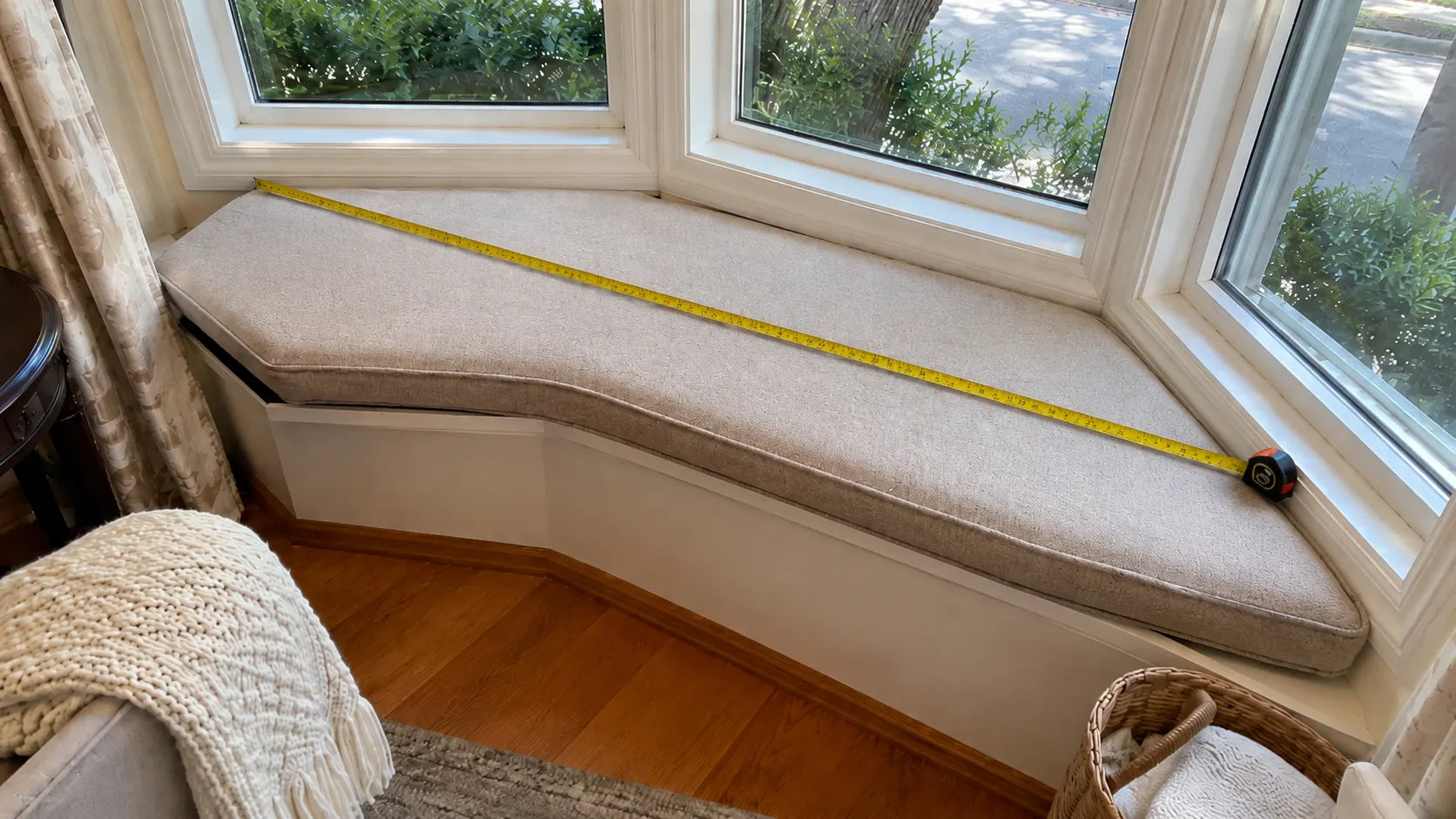
This is the same logic we use for other irregular openings — our bay window measuring guide walks through the template method in more detail, and it translates directly to a curved hearth edge. If your hearth has an irregular or trapezoid-shaped extension, we also build cushions off exactly this kind of template — our custom trapezoid cushion option was built for non-rectangular spaces like this one.
Will Fireplace Heat Make Foam Off-Gas or Break Down Faster?
This is the question people ask us quietly, almost like they're embarrassed to bring it up — and it's honestly the smartest one on this list. Flexible polyurethane foam, the material inside most cushions, has a general continuous-use ceiling of somewhere around 200°F (93°C) before its physical structure starts to break down; below that, it behaves normally. The bigger concern isn't total combustion, it's cumulative heat exposure slowly degrading the foam and accelerating off-gassing of volatile organic compounds (VOCs) — warm air generally speeds up how quickly materials release trapped compounds, foam included.
Why this matters more near a fireplace than a regular sofa:
A working masonry hearth surface and the glass front of an insert can both run meaningfully hotter than ambient room air, even a few feet out. Combined with radiant heat during a long burn, a cushion sitting too close to the firebox opening — rather than out on the code-mandated hearth extension — is exposed to more cumulative heat than a cushion anywhere else in your house. It's part of why we leave that open center gap between the two cushion pieces rather than covering the hearth edge to edge — the zone directly in front of the firebox, where heat and stray embers concentrate most, stays bare stone with no fabric at all.
Two things reduce the risk to essentially nothing. First, keep the cushion on the outer hearth extension, not pressed against the firebox opening or insert door — which lines up naturally with the fire-code clearance discussed below. Second, look for foam that's CertiPUR-US certified, meaning it's independently lab-tested for VOC emissions under 0.5 parts per million and screened against ozone-depleting chemicals, heavy metals, formaldehyde, and phthalates. It's not a heat rating exactly, but it's a solid proxy for "this foam was made without the chemistry that tends to cause off-gassing problems in the first place," warm room or not.

Turning a Cold, Hard Hearth Into Somewhere People Actually Sit

I'll admit this part isn't really about safety, it's about the fact that a bare stone or tile hearth is genuinely miserable to sit on for more than about ninety seconds. Once there's a properly fitted cushion on it, that whole ledge turns into legitimate extra seating — a spot for kids during game night, overflow seating when the sofa's full, or honestly just a better reading corner than the actual reading chair most people bought and never use. It's one of the more satisfying "small change, big difference" upgrades we build for, right up there with a proper indoor bench cushion for an entryway or window nook.
If you're outfitting more than one space at once — hearth plus a window seat, say — it's worth timing it: we're currently running $60 off orders over $300, and $125 off orders over $500.
Fabric That Can Handle Ash, Soot, and Daily Traffic
Fireplace zones collect fine soot dust even when nobody's actively cleaning the firebox, plus foot traffic, dropped kindling bark, and the occasional marshmallow incident. Skip anything with a raised pile — chenille and velvet trap soot in the weave and are miserable to spot-clean. A tightly woven cotton-poly canvas or a performance polyester with a wipeable finish is the more practical call: dense weave, low nap, and it wipes clean with a damp cloth instead of needing a vacuum attachment every week. If you want the fuller comparison, our guide on cleaning fabric cushions covers spot-cleaning methods that work well for this kind of everyday grime.


Frequently Asked Questions
Are fireplace hearth cushions flame retardant or fireproof?
They're flame retardant and smolder-resistant, not fireproof. No fabric cushion is immune to direct, sustained flame contact.
- Flame retardant / smolder-resistant means the materials resist ignition from sparks, embers, or a dropped cigarette (the CAL 117 / 16 CFR 1640 test standard).
- Fireproof would mean the material can't burn at all — that's not a real claim for a fabric-and-foam product.
- Keep cushions on the hearth extension, not touching the firebox opening or glass insert door, regardless of the fabric's rating.
How do you baby-proof a brick or stone fireplace hearth?
A properly fitted cushion is the fastest fix for a hard hearth edge, but full baby-proofing takes a few extra layers.
- Add a corner and edge cushion or padded guard along the entire hearth perimeter, not just the top surface.
- Anchor a fireplace safety gate in front of the opening if a child could reach the firebox itself.
- Choose a cushion thick enough to round off the impact — thin decorative pads don't absorb much of a fall.
- Remove sharp mantle-level decor while children are in the crawling and cruising stage.
What is the standard depth of a fireplace hearth cushion?
There isn't one universal number, because hearth depth is dictated by fire code minimums, not furniture standards.
- Most residential building codes require hearth extensions of at least 16 inches in front of a standard fireplace opening.
- Openings 6 square feet or larger typically require at least 20 inches of hearth extension in front.
- Side extensions are usually a minimum of 8 to 12 inches depending on opening size (see the code language on hearth extension dimensions for the exact breakdown).
- Because actual hearth depth varies by home, measuring your specific ledge is the only reliable way to get a cushion that fits — see the measuring section above.
How do you attach a cushion to a stone fireplace without damaging the stone?
Skip adhesives and drilling entirely — neither is necessary and both risk permanent damage to natural stone.
- Weighted, well-fitted pieces often don't need attachment at all if the template match is tight.
- Non-slip rubber or silicone matting placed underneath each piece adds grip without any adhesive contact with the stone.
- Removable hook-and-loop tabs can attach to the cushion's underside and press against textured stone without leaving residue, though they grip better on rougher stone than polished surfaces.
- Building the cushion as two separate pieces also makes lifting one side off for cleaning, or resetting it after it shifts, much simpler than repositioning one long slab.
- Avoid double-sided tape or construction adhesive — both can stain or etch natural stone when removed.
Can you sit on a fireplace hearth with a cushion?
Yes, in most homes a masonry hearth is built to support seating weight without issue.
- Masonry and stone hearths are structural, load-bearing surfaces designed to support far more than typical body weight.
- A cushion with enough loft (2-3 inches or more) makes the ledge comfortable for actual sitting, not just perching.
- This works whether the fireplace is actively in use in cooler months or sitting cold as extra seasonal seating.
What material is best for a fireplace hearth pad cover?
A tightly woven, low-nap fabric with a wipeable finish is the best match for this environment.
- Cotton-poly canvas or performance polyester both resist soot staining better than fabrics with texture or pile.
- Wipeable or lightly coated finishes make ash smudges a quick clean instead of a deep-clean project.
- Darker or heathered colorways hide fine soot dust better between cleanings than solid pale colors.
- Avoid velvet, chenille, or boucle — the raised texture traps soot and is difficult to fully clean.
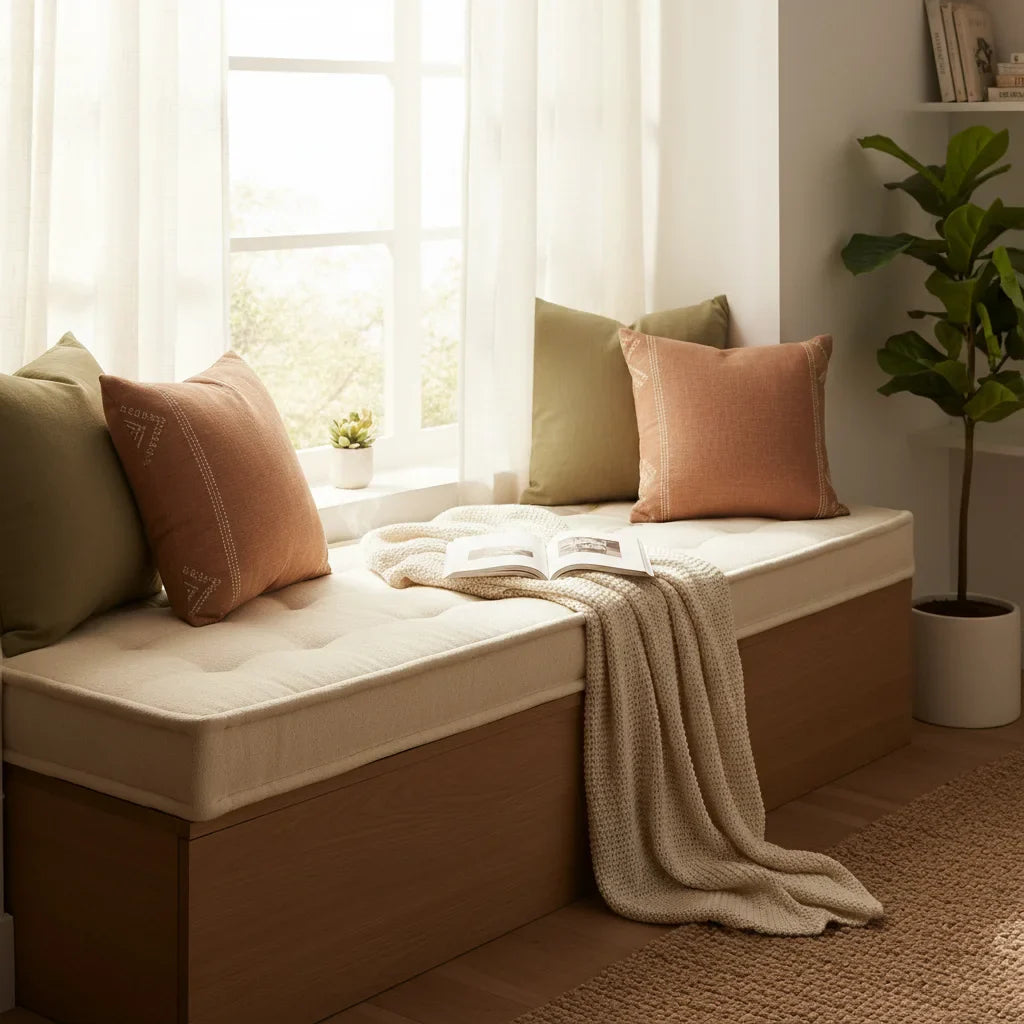
Custom Trapezoid / Curved Cushion
Built from your template for stone edges, moldings, and non-rectangular hearths.
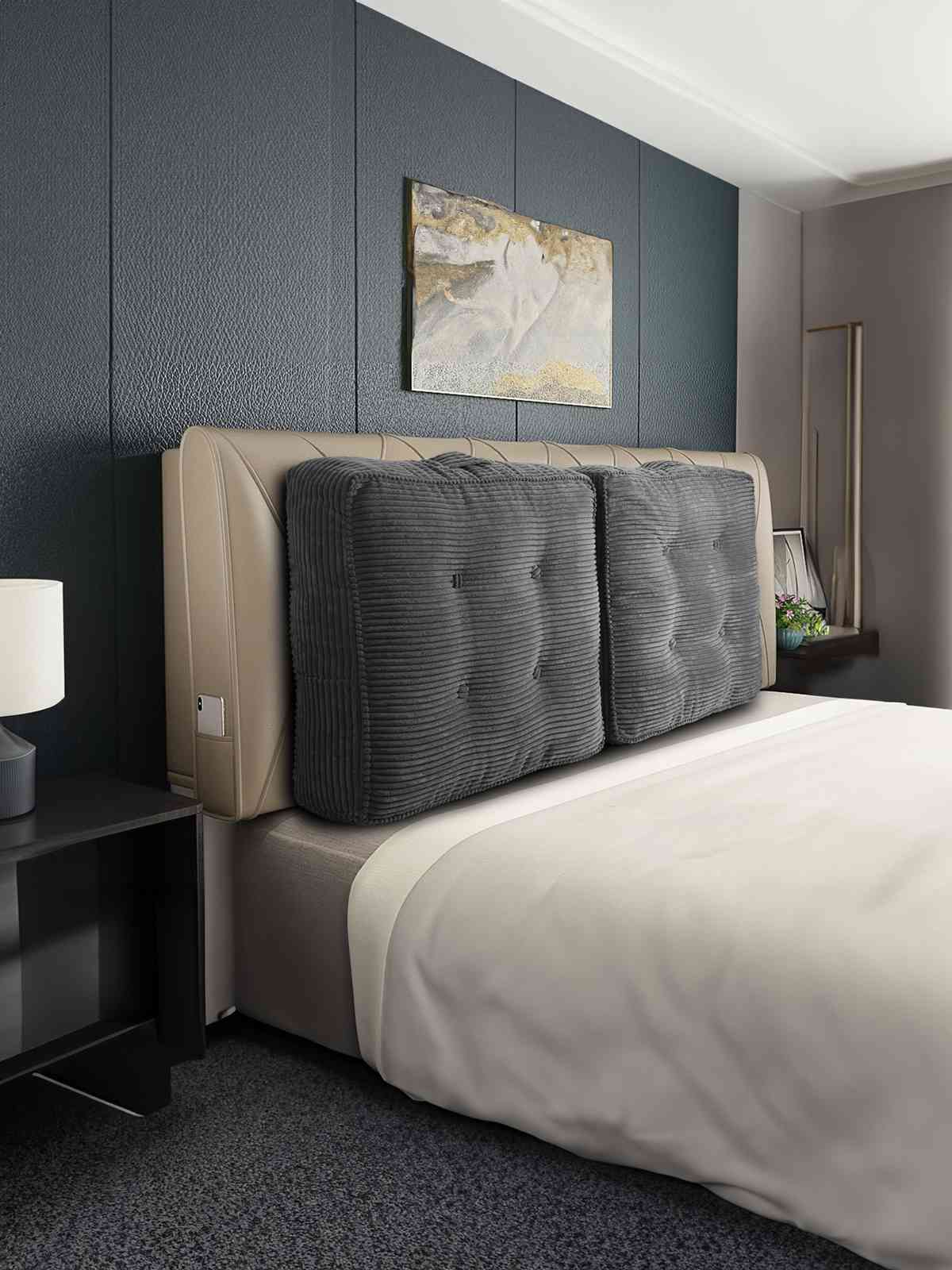
Shop custom shapes →Custom Tufted Cushion
A tailored, decorative option for hearths that double as a family room accent.
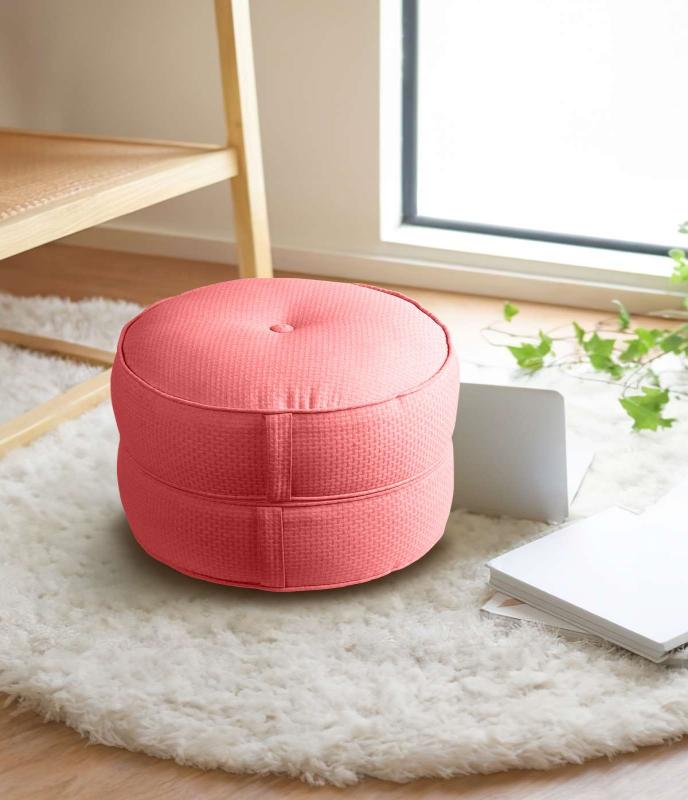
Shop tufted cushions →Cozy Corner Floor Cushion
Extra low-profile padding for the floor space right in front of the hearth.
Shop floor cushions →If your hearth is one of the tricky ones — curved stone, an odd taper, a raised ledge that doesn't match anything off-the-shelf — send us a few photos and rough measurements. We build to templates every week, and fire-safety compliance isn't something we treat as optional.


Leave a comment
All comments are moderated before being published.
This site is protected by hCaptcha and the hCaptcha Privacy Policy and Terms of Service apply.